Australia just made international headlines for the wrong reason.
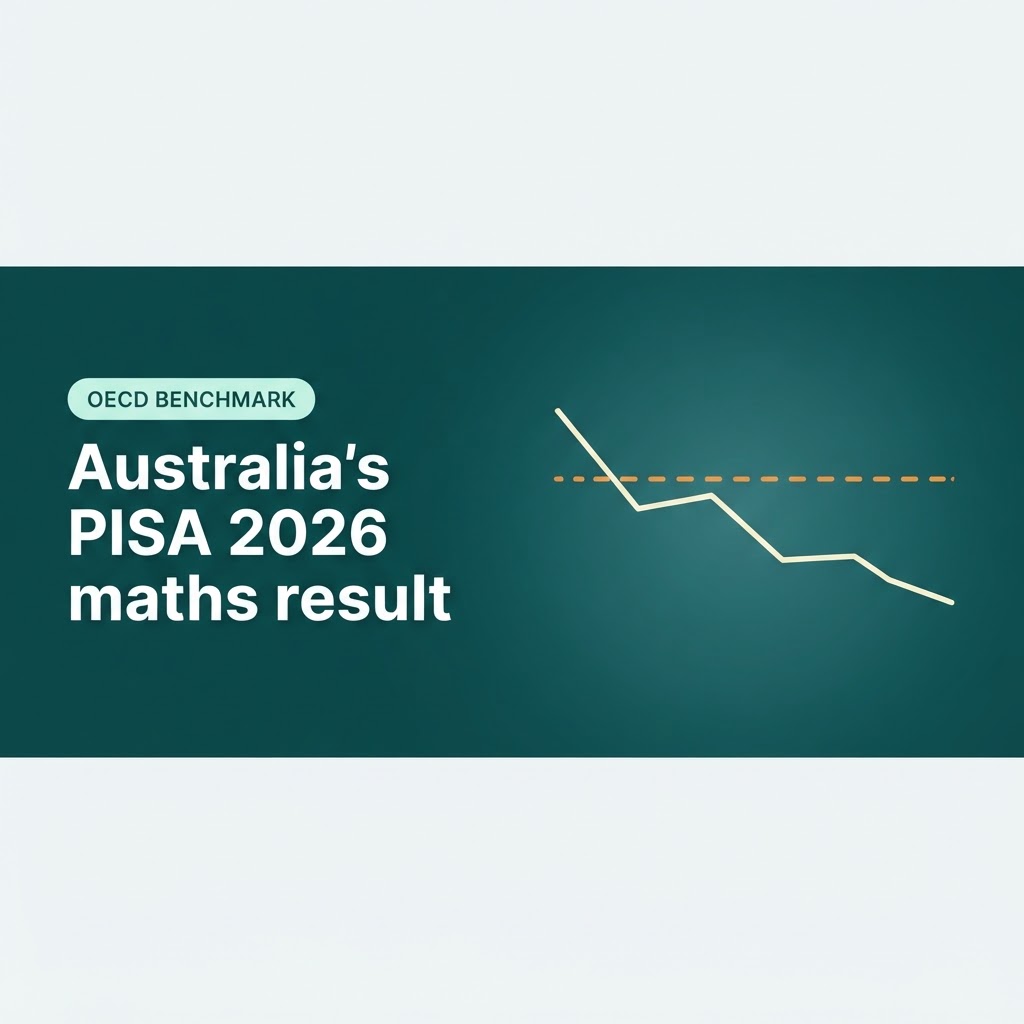
The 2026 PISA results, released this month, show Australian students have slipped below the OECD average in mathematics for the first time since the test began in 2000. Mean maths score: 477 points. OECD average: 489. Australia's global ranking: 20th out of 37 nations, down four places in four years.
Education Minister Jason Clare called it "a wake-up call". School principals across the country are already fielding calls from worried parents. But after the headlines settle, the real question is the one every Brisbane parent is quietly asking: is my child in the group that is falling behind, and what can I do about it at home?
What did the PISA 2026 results actually show?
PISA (Programme for International Student Assessment) tests 15-year-olds across maths, reading and science in every OECD country. The 2026 Australian results:
- Maths: 477 points (down from 487 in 2022), now below the OECD average of 489
- Science: 491 points (down 12 points from 2022)
- Reading: 498 points, still above the OECD average of 476
The average drop sounds modest. The gap underneath it is not. The top 10 per cent of Australian students performed at the same level as peers in Singapore and Japan. The bottom 25 per cent are now more than two years of schooling behind the national average. The decline is not happening to everyone. It is happening sharply to the students who quietly slip out of step with the curriculum and are never pulled back in.
Why does the gap between the top and bottom matter more than the average?
An average of 477 tells you almost nothing about your own child. The spread does. Australia now has one of the widest gaps in the OECD between its strongest and weakest students, which means the national result is really two very different stories.
Two years of schooling behind is not a single bad term. It is the compounding effect of small, unaddressed gaps: a fractions unit that never quite landed in Year 4, a reading comprehension skill that was assumed rather than taught, a topic missed during a fortnight of illness. Classrooms of 25 to 28 students move forward on schedule whether or not every child has consolidated the previous step.
That is why the strongest predictor of which group a child ends up in is not raw ability. It is whether someone noticed the gap early and did something about it.
What role do parents actually play in this?
More than most parents realise, and less than the PISA headlines imply.
You are not expected to teach the Australian Curriculum at your kitchen table. What you can do is the thing no teacher with 27 other students can do reliably: notice your specific child slipping, and act while the gap is still measured in weeks rather than years.
The research is consistent on this point. Sustained parental involvement, meaning regular attention to what a child is learning and prompt support when they struggle, is one of the strongest influences on academic outcomes across every OECD country. Involvement, not instruction.
In practice that means three things:
- Know where your child sits rather than assuming a passing report card means no gaps
- Act on the first signal, not the third or fourth term of drifting results
- Get targeted help for the specific gap, instead of general extra worksheets
What are the early warning signs in a Year 3 to Year 6 child?
The students in the bottom quarter of PISA did not arrive there at 15. The signals were visible years earlier, and they are usually mild enough to be easy to miss.
- Confident with a memorised method, but stuck when the same idea appears in an unfamiliar context
- Can find stated facts in a passage, but misses implied meaning and inference
- Strong on routine homework, noticeably slower on timed or unexpected tasks
- Says a topic is "boring" or "pointless", which is often how a child describes a topic they never fully understood
- Homework that used to take 20 minutes now takes an hour, or quietly stops being mentioned
None of these mean your child is struggling. They mean a specific skill has not been consolidated, and that is a straightforward problem to solve when it is caught early.
What should Brisbane parents do this term?
The PISA results do not call for panic. They call for a deliberate look at where your own child currently sits.
Step 1: Read your child's NAPLAN individual student report properly.
It is available through the MySchool portal. Look at the numeracy and reading proficiency levels rather than the overall result. A child in the "developing" or "needs additional support" range is in the cohort the PISA data is flagging. A child in "strong" or "exceeding" is tracking well, but the report will still show you which specific strand is weakest, and that is where support pays off most.
Step 2: Ask one specific question at the next parent-teacher meeting.
"Can my child apply a maths method to a problem they have not seen before, or do they rely on the method they memorised?" The answer tells you far more than a report card grade, and it gives you something concrete to work on.
Step 3: Close the gap you found, not a general one.
This is where most families lose momentum. A child who is behind on fractions does not need more maths in general. They need the fractions gap closed, then the next step built on top of it. Targeted work, sequenced in the order the curriculum actually teaches it, is what turns a diagnosis into progress.
Step 4: Make the test format familiar before it counts.
NAPLAN in Year 3, 5, 7 and 9 is not a high-stakes exam, but it is the clearest external checkpoint most families get. Children who have never seen the question style spend their first ten minutes adjusting to it. Children who have practised in the same format spend those ten minutes answering questions, and the report you receive afterwards reflects what they actually know rather than how unfamiliar the paper felt.
How can AIM Study help close the gap?
Everything above is work a parent can start this week without any outside help. Where families come to us is the point after the diagnosis, when they know which gap exists and want it closed properly.
- Curriculum aligned tutoring works through the Australian Curriculum in sequence, so the gap you identified is closed in the order the classroom will build on it. This is the option for a child who is drifting in maths or English and needs the foundation rebuilt rather than more practice on top of a shaky base.
- NAPLAN preparation for Year 3, 5, 7 and 9 makes the format familiar and turns the report into useful information. It also surfaces gaps that a school report card can hide.
- QASMT and BSHS mock tests are for families already aiming at selective entry, where applied reasoning under time pressure is the skill being assessed.
Our 2027 programs across all three are being planned now. If your child is in Year 3 to Year 6, this is the window where starting matters most. Not because any exam is imminent, but because small gaps closed early compound in exactly the way the PISA spread demonstrates, and a single sprint in the final term cannot replicate that.
Places are capped so each student gets genuine attention, and several 2026 dates closed before their cut-off.
Join our waitlist to get an update when we launch our 2027 campaigns